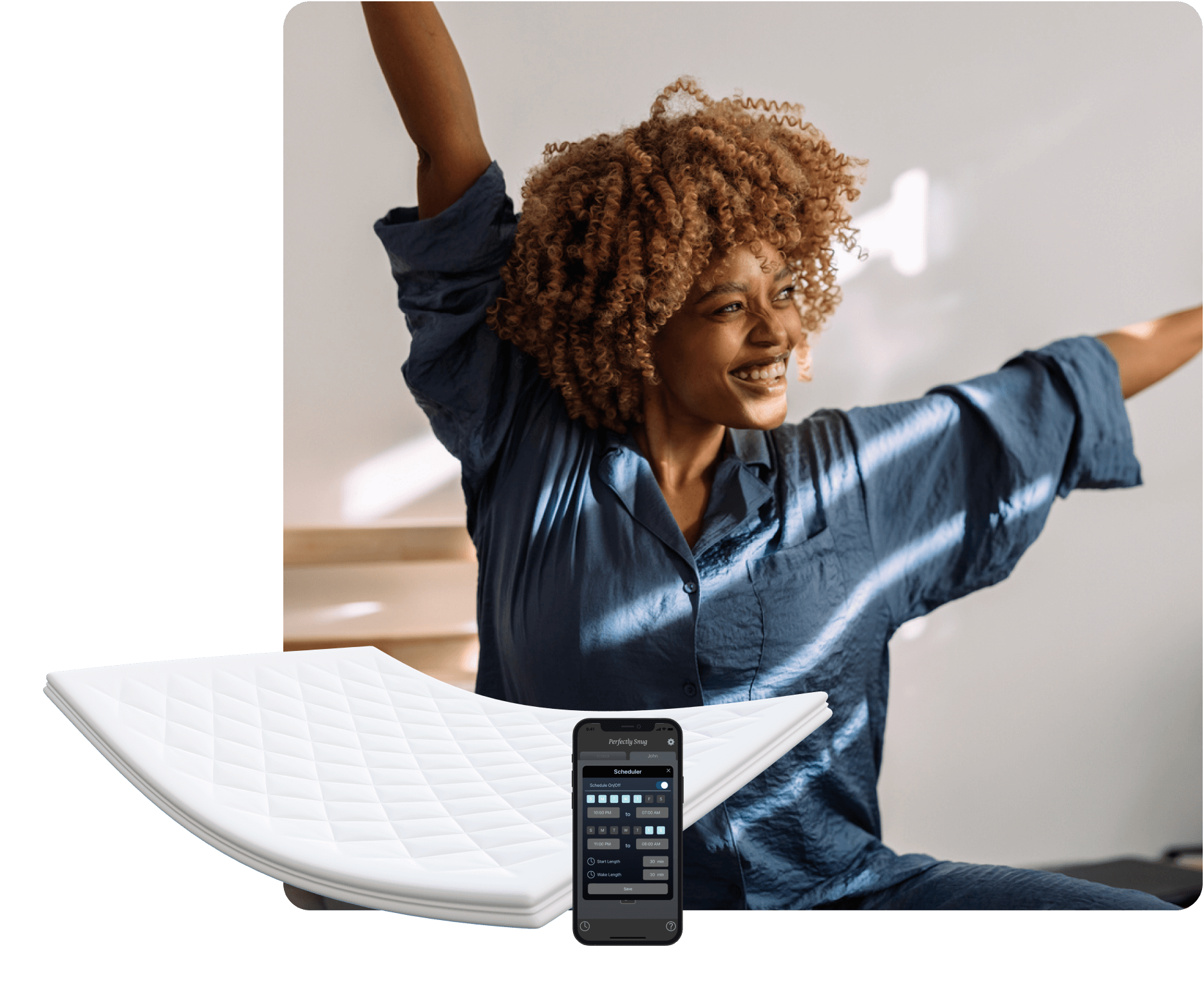
In 2025, we partnered with Dr. Daniel Gartenberg and his team at SleepSpace to run an independent clinical study on the Perfectly Snug Smart Topper. Dr. Gartenberg is a cognitive psychologist and sleep researcher whose work has been published in peer-reviewed journals. SleepSpace recruited and managed the participants independently. Here's what they found.
Who was in the study
58 participants enrolled. 22 completed all four survey checkpoints across the three-week study period. The gender breakdown was 55% female and 45% male, with an average age of 45.7 years.
The study used a randomized crossover design: during two of the three weeks, participants were randomly assigned to either use the topper or turn it off. This means the results aren't just before-and-after comparisons -- participants were measured against themselves under both conditions.
Sleep was tracked daily using the Consensus Sleep Diary, a clinically validated instrument, alongside two widely used assessment tools: the PROMIS scale for sleep quality and the Epworth Sleepiness Scale for daytime alertness.
What the study found
-
100% of participants reported improved sleep when using the topper.
-
85% said they fell asleep faster.
-
76.7% reported improvement in perceived deep sleep.
-
75% reported more or better-quality dreams, which researchers noted as an indicator of improved REM sleep.
-
80% reported that their sleep partner also experienced fewer disruptions -- less movement, less snoring -- even though the study focused on the primary user.
- 90% reported less tossing and turning.
The Net Promoter Score was 81.8%. Industry convention classifies anything above 70 as world-class.
The Epworth result
The Epworth Sleepiness Scale is a validated clinical tool used by sleep medicine practitioners. It's not a satisfaction survey. It measures alertness across eight daytime scenarios and is used to screen for sleep disorders.
A two-point change on the Epworth is considered clinically significant.
Participants in this study showed a 2.77-point improvement in daytime alertness when using the topper versus when they weren't. That exceeds the threshold for clinical significance -- meaning participants weren't just reporting that they felt better. The data showed it.
A note on methodology
Dr. Gartenberg was transparent about the study's limitations. Participants weren't blinded -- they knew whether the topper was on or off -- which introduces the possibility of placebo effects. Objective sleep data from wearables or lab testing wasn't collected alongside the surveys, so the deep sleep and REM improvements are perceived rather than EEG-confirmed.
Future research with blinded conditions and objective measures would strengthen the findings. That said, a 100% participant improvement rate and a clinically significant Epworth result are not easy numbers to dismiss.
Read the full study
The complete findings, methodology, and researcher analysis are published on the SleepSpace website:
Read the full SleepSpace study by Dr. Daniel Gartenberg
The Smart Topper comes with a 30-night risk-free trial. If your sleep doesn't improve, return it for a full refund. Try the Smart Topper