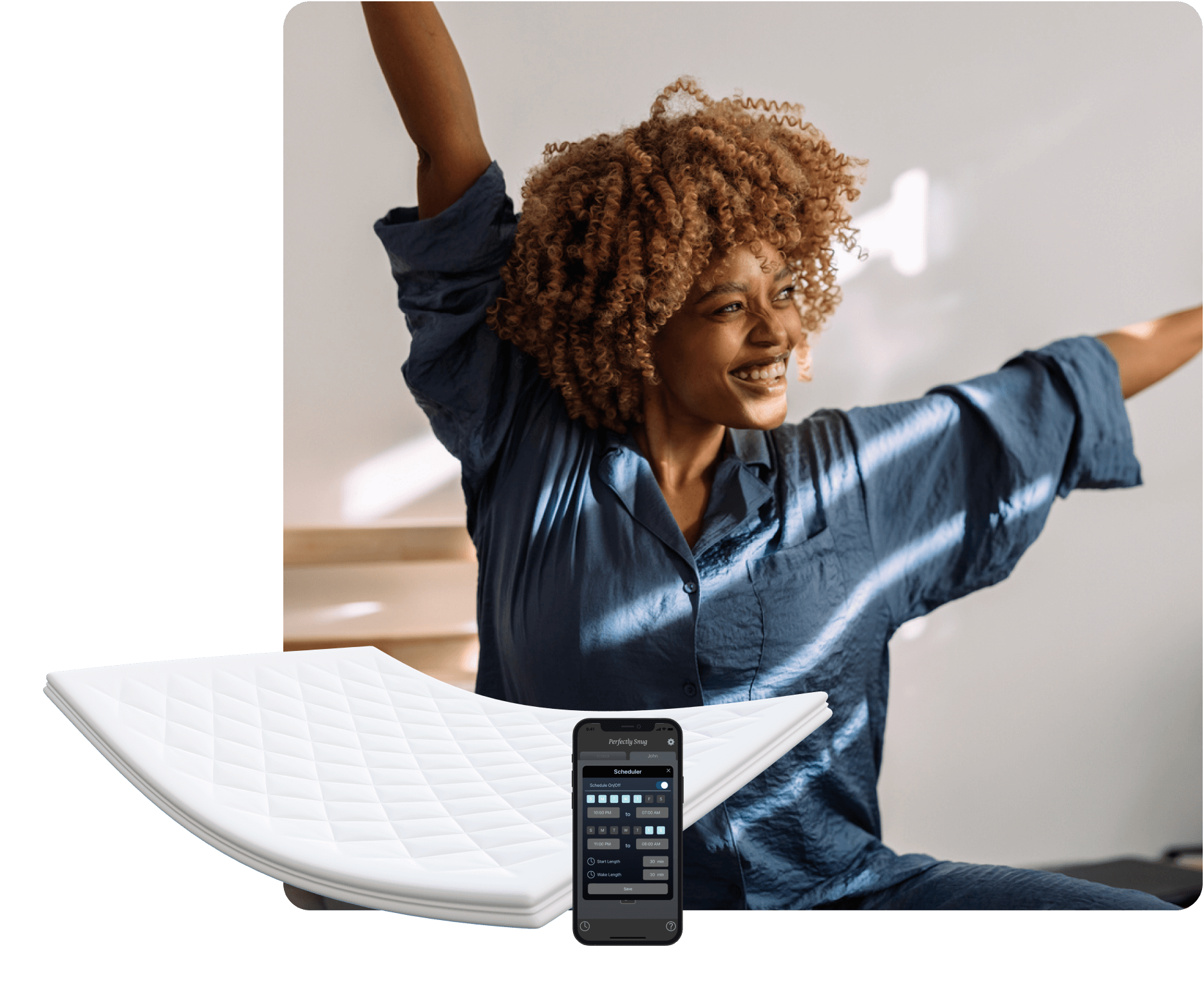
Yahoo Health recently looked into a question hot sleepers ask all the time: do cooling mattresses actually work, or do they just feel cool for a few minutes? In a feature by Sally Wadyka, updated May 21, 2026, the article pulled together sleep medicine experts, thermal engineering insight, and market data to sort out which cooling claims really hold up. Perfectly Snug's Smart Topper was mentioned in the fan-powered active cooling category. More importantly, the article landed on the same conclusion we have seen for years: sustained airflow matters more than a cold first touch.
What Yahoo Health Set Out to Investigate
This was not a typical product roundup. It was a science-first look at whether the most common cooling technologies, from gel foams and phase change materials to active systems, actually keep sleepers comfortable through the night.
The sleep-heat problem is bigger than it sounds
A Gallup poll cited in the article found that 57% of adults say overheating disrupts their sleep at least occasionally, and 14% say they are almost always too hot to sleep well. The piece also referenced a 2024 National Sleep Foundation survey of more than 2,000 adults, which identified cool temperature as the single most important environmental factor for good sleep. That helps explain why the cooling mattress market is still growing so quickly, and why more and more sleepers are turning to Perfectly Snug for help.
The real question was not first-touch coolness
The article pushed past the usual marketing language. It was not asking which product feels coolest when you first climb into bed. It was asking which technology still works hours later, when most people wake up overheated. That is the better question, and it led the reporting away from surface sensations and toward overnight performance.
What the Experts Said About Cooling Technology
The experts quoted in the piece approached the topic from different angles, but their conclusions were remarkably consistent.
"Cool to the touch" runs out of runway
Ken Diller, an engineering professor at the University of Texas at Austin, was direct about phase change materials: once the material warms up, he says, "it's done soaking up heat for the night." That is the built-in limitation of passive cooling. It can absorb heat for a while, then it stops acting like a cooling technology and starts acting like a warmed layer under your body.
For anyone who falls asleep comfortably but wakes up overheated later, that point is hard to ignore.
Airflow is what keeps cooling going
Shahab Haghayegh, an instructor in the division of sleep medicine at Harvard Medical School, offered one of the clearest lines in the article: "The more air can pass through the structure of the mattress, the better." He also noted that it is "a misconception that 'cooling' automatically means better sleep."
That is a useful distinction. A cool sensation is not the same as lasting temperature regulation. What matters is whether the system keeps working after the novelty wears off.
Why body temperature matters so much
Dr. Ashtaad Dalal, a sleep medicine specialist and member of the American Academy of Sleep Medicine, explained the biology behind all of this: "A drop in core body temperature is one of the most important signals that initiates and maintains sleep." When the sleep surface traps heat and interferes with that drop, he noted, "sleep tends to be lighter, less restorative and more fragmented."
His description of a good active system was especially useful: "It doesn't have that initial cool-to-the-touch sensation, but it doesn't progressively warm up while you're sleeping."
That lines up closely with what we covered in our post on temperature regulation and sleep quality. The goal is not a cold shock at bedtime. The goal is a stable sleep environment that supports the body's own cooling process for hours.
Where Perfectly Snug Fits In
The Yahoo Health article cited the Perfectly Snug Smart Topper as an example of a fan-powered active cooling system, and noted that using built-in fans instead of water may mean less maintenance than water-based competitors. You can read the full feature at Yahoo Health.
Built around airflow, not surface treatments
The Smart Topper was built around the same principle Haghayegh described: airflow. It uses active airflow driven by quiet internal fans to help move heat away from the sleeper over the course of the night.
That matters because passive cooling materials eventually hit a wall. Airflow does not "fill up" the same way. It keeps moving. It keeps exchanging heat. It keeps doing the work after bedtime.
If you want to see how that airflow-first approach works in practice, we highly recommend giving Perfectly Snug a try. With a 30 night trial and free shipping (delivery and returns), you have nothing to lose an everything to gain.
A practical alternative to water-based systems
The article also noted that fan-based systems like the Smart Topper may require less maintenance than water-based competitors. No hoses, no reservoirs, no refilling. The Smart Topper runs on low-voltage DC power, with no external components beyond the power cord behind the headboard.
For shoppers comparing air and water systems, that is not just a convenience detail. It shapes the whole ownership experience.
Dual-zone control solves a real couple problem
The Yahoo Health piece also pointed to menopause-related temperature swings as a major reason active cooling has become more relevant. That is where dual-zone control matters. Each side of the Smart Topper operates independently, so one partner can stay cool while the other sleeps at a completely different temperature.
For couples dealing with night sweats or hot flashes, that removes the usual compromise of a single shared sleep temperature.
What Coverage Like This Actually Tells You
Publications like Yahoo Health do not usually take brand claims at face value. When a product appears in a piece built around expert interviews and technical scrutiny, it says something about the category it belongs to.
In this case, the Smart Topper was not mentioned because it creates a dramatic cold-touch first impression. It was mentioned in a story that spent a lot of time explaining why active airflow tends to outperform passive materials across a full night of sleep.
The research and the product point the same way
A Harvard sleep medicine instructor points to airflow. A University of Texas engineer explains why passive materials fade out. A sleep medicine specialist makes the case for sustained cooling over a cold first touch. Then Yahoo Health cites the Smart Topper as an example of that airflow-based approach.
That is what makes the mention meaningful. The research and the product are answering the same question in the same way.
Better sleep comes from a system, not a sensation
Anyone shopping for a cooling sleep solution would do well to read the full Yahoo Health feature first. It gives you a much better filter for evaluating any product. Do not ask only how it feels in the first five minutes. Ask how it performs at 3 a.m.
If you want to go deeper, our comparison of smart topper technology and whole-room cooling is a helpful next read before making a decision.
And if you're ready to explore the product itself, we're happy to help.
Frequently Asked Questions
Q: Where can I read the Yahoo Health article that mentioned Perfectly Snug?
A: The full article, "Do Cooling Mattresses Actually Work? Here's What the Science Says" by Sally Wadyka, is available at Yahoo Health. It was updated May 21, 2026 and includes expert commentary from Harvard Medical School, the University of Texas at Austin, and the American Academy of Sleep Medicine.
Q: What did Yahoo Health say about the Perfectly Snug Smart Topper specifically?
A: The article cited the Smart Topper as a fan-powered active cooling option, noting that its use of built-in fans rather than water may mean less maintenance than water-based competitors.
Q: What do sleep experts say makes a cooling mattress actually effective?
A: Experts interviewed in the Yahoo Health piece consistently pointed to airflow and sustained cooling as the key variables. Harvard sleep medicine instructor Shahab Haghayegh stated that "the more air can pass through the structure of the mattress, the better." Passive materials like gel foam and phase change covers were noted as having limited sustained benefit once they reach their heat-absorption capacity.
Q: Does the Smart Topper cool or heat?
A: Both. The Smart Topper is a dual-zone active air cooling and heating system, allowing each side of the bed to be set independently for cooling or warming.
Q: Is the Smart Topper difficult to maintain?
A: No. It requires no ongoing maintenance. The cover is spot-cleanable and fully removable for washing, and there are no hoses, reservoirs, or external components to manage beyond the power cord.