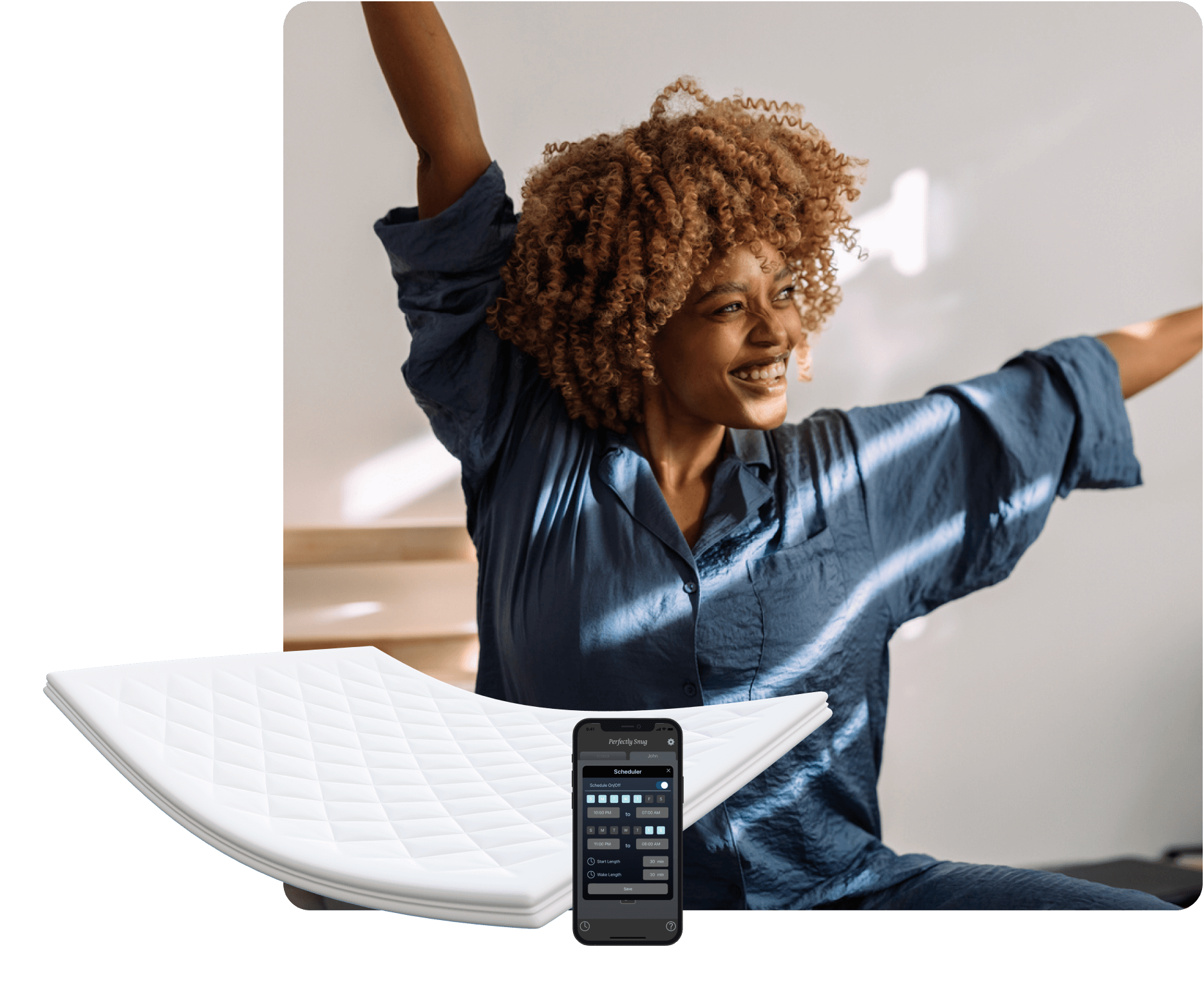
In 2025, sleep researcher Dr. Daniel Gartenberg ran a randomized controlled study on 58 people using the Perfectly Snug Smart Topper. Dr. Gartenberg has a PhD in cognitive psychology from Penn State, where he is also an adjunct professor in the Department of Biobehavioral Health. He is the founder and CEO of SleepSpace, a clinical-grade sleep tracking platform, holds 4 patents, has tens of peer-reviewed publications, and received over $3 million in research grants from the National Science Foundation and the National Institute on Aging. His TED Talk on deep sleep has over 4 million views. The results of the study were unusually strong.
Here's what they found.
The study design
Participants were recruited through SleepSpace's user base. To qualify, they needed a smartphone and had to stay home for the full three-week period. They tracked their sleep daily using the Consensus Sleep Diary, a validated clinical instrument, and received weekly surveys measuring sleep quality (via the PROMIS scale) and next-day alertness (via the Epworth Sleepiness Scale).
The study had a randomized crossover design. For two of the three weeks, participants were randomly assigned to either use the topper or turn it off. This is the critical detail that separates this from a typical testimonial study: participants weren't just asked "did you like it?" They were compared against themselves, sleeping with and without the topper, in randomized order.
22 participants completed all four survey checkpoints. Their average age was 45.7 years. 55% were female.
The numbers
100% of participants reported improved sleep when using the topper. Every single participant who completed the study said their sleep improved.
85% reported falling asleep faster.
76.7% reported improvement in perceived deep sleep compared to the nights without the topper.
75% reported more dreams, or better-quality dreams (a reliable indicator of improved REM sleep). REM sleep is when the brain consolidates memory, processes emotion, and performs cognitive restoration. Most people in sleep debt are REM-deficient.
More than 75% reported less tossing and turning, with the study noting their sleep was "more peaceful or very peaceful" compared to nights without the topper.
80% reported that their partner also slept better, even though the study was focused on the primary user. Less movement and temperature disturbance from one partner has a measurable effect on the other.
The Net Promoter Score was 81.8%. Industry convention classifies anything above 70 as "world-class."
The Epworth result
The Epworth Sleepiness Scale is a validated clinical tool used in sleep medicine, rather than a satisfaction survey. It measures how likely you are to fall asleep in eight different daytime situations, from sitting quietly to riding in a car. Doctors use it to screen for sleep disorders. A two-point change on the scale is considered clinically significant.
Participants in this study showed a 2.77-point improvement on the Epworth when using the topper versus when they weren't. That exceeds the clinical significance threshold.
To put it differently: participants were measurably more alert during the day when they used the topper. Not self-reportedly more alert, but measurably on a clinical instrument.
Why temperature works
The science behind this isn't new. Your circadian rhythm is tightly coupled to your core body temperature. When you fall asleep, your core temperature drops. When you're in deep sleep, your body's thermoregulation continues working to keep you in the right zone. When you're in REM sleep, thermoregulation is significantly hindered, which is why the ambient temperature under and around you matters more than at any other sleep stage.
A study of 1.75 million nights of sleep data published by Sleeptracker-AI found that cooler sleep environments correlate with longer sleep duration and higher REM percentages. The Perfectly Snug system doesn't just cool the room. It creates a microclimate under and around the body, adjusting in real time using a skin-temperature sensor, accurate to within 0.2 degrees Fahrenheit. It makes tens of thousands of automated temperature adjustments over the course of a single night.
That's what you're buying, is active thermoregulation rather than just a cooler bed.
What the study doesn't claim
Dr. Gartenberg was upfront about the limitations. Participants weren't blinded, meaning they knew when the topper was on or off. A blinded design would have been stronger. Objective sleep data from wearables or polysomnography (lab sleep testing) wasn't collected alongside the subjective surveys, so the deep sleep and REM improvements are perceived, not measured via EEG.
Future research addressing those limitations would strengthen the findings. But those are the standard limitations of a real research study, not a marketing document. The transparency is itself a signal worth noting.
What makes this study worth reading
Clinical research on sleep technology varies a lot in quality. The Perfectly Snug study used a randomized crossover design (participants were compared against themselves sleeping with and without the topper, in randomized order) which is a stronger methodology than before-and-after surveys or anecdotal data. The researcher and institution are independent. The results are published publicly at sleepspace.com, not behind a company login.
Dr. Gartenberg also chose to publish the limitations alongside the findings, which is typical of academic research.
The bottom line
If you're trying to decide whether Perfectly Snug is worth the investment, this study is the most honest piece of data available. The numbers are strong and the methodology is sound. The limitations are real but typical. And the core finding, that 100% of participants slept better with the topper than without it, is hard to argue with.
The Perfectly Snug Smart Topper comes with a 30-night risk-free trial. If it doesn't improve your sleep, return it.
Read the full SleepSpace study
See Perfectly Snug's Performance & Specs Data
Try the Smart Topper