Peggy is a 59-year-old bank executive; a woman who spent her career trusting data, building spreadsheets, and making decisions based on numbers. When she started struggling with sleep in her fifties, she did what made sense to her: she bought an Oura Ring and started tracking.
Every morning she woke up and checked her readiness score. Every morning, the numbers confirmed what she already knew: She was sleeping badly.
The ring was accurate (which any professional appreciates), but it couldn't do anything to solve her problem.
"I would wake up, check my app, and see a low sleep score," she wrote on her site, Her Executive Stack. "Even if I felt decent, seeing those numbers made me feel like a failure before I even had my first cup of coffee."
She eventually stopped wearing the ring.
The tracking trap
There is a documented phenomenon called orthosomnia: sleep anxiety caused by sleep tracking. Researchers at Rush University Medical Center published a case series on it in 2017. Patients were developing insomnia because they were so focused on their sleep data that the act of checking it was disrupting their sleep.
"Sometimes, the numbers just create more noise and, in my case, more anxiety," Peggy wrote. "Every morning, I felt like I’d failed once more as I checked my Oura App sleep numbers."
This is the limitation of most sleep tech: wearables are diagnostic tools. They tell you how you slept, but can neither control the environment you sleep in nor create the deep peace and relaxation actually conducive to a good night's sleep.
What HRT fixed and what it didn't
Peggy started Hormone Replacement Therapy six years before she found Perfectly Snug. HRT made a significant difference for her. It stabilized her energy, helped with mood, and addressed a lot of the hormonal volatility that comes with the menopause transition.
But she was still waking up overheated.
This is a gap that doesn't get talked about enough. HRT raises the threshold at which the hypothalamus triggers a hot flash response, but it doesn't eliminate every event. And even with effective HRT, the sleep environment itself matters. If you're running warm at 2am, you're still going to wake up, strip off covers, get cold, pull them back on, and repeat the cycle until your alarm goes off.
The hormone side was handled. The environmental side wasn't.
What changed
Peggy tried the Perfectly Snug Smart Topper and combined it with her HRT regimen. The result, in her words: "The night sweats didn't just decrease. They vanished."
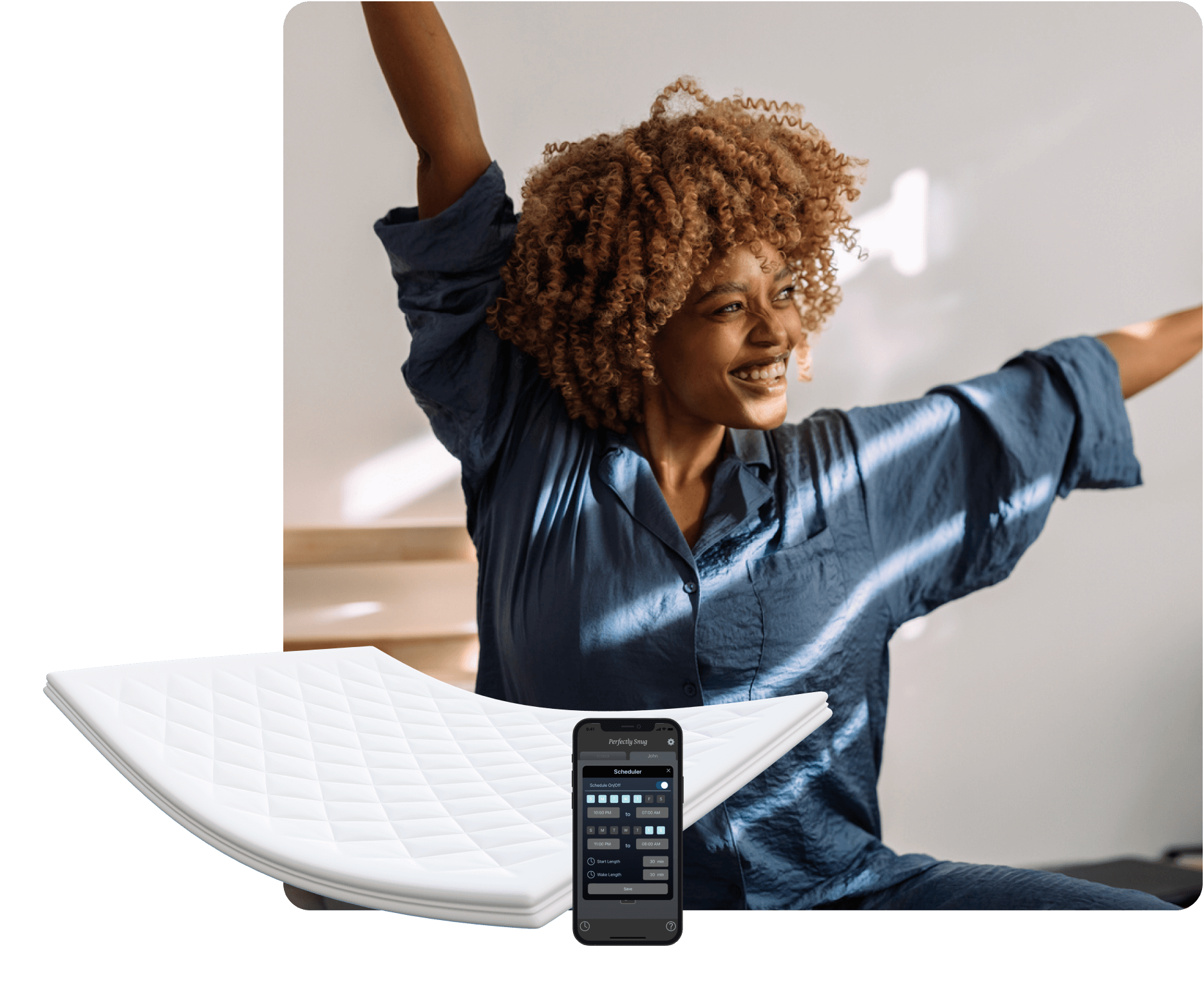
The Smart Topper works by circulating air through a patented 3D mesh structure that sits beneath you. It pulls heat away from the body continuously, adjusting in real time based on a skin-temperature sensor. When she felt a sudden burst of heat, she could reach out and press a physical button on the side of the topper to trigger a cooling burst, without picking up her phone, without a screen, without waking up fully.
That detail about the physical buttons matters more than it sounds. Every time you look at a phone screen at 2am, you expose your brain to blue light and the cognitive pull of notifications, apps, and information. For someone whose job involves being sharp at 7am, that's a meaningful operational risk. The topper's embedded manual controls bypass all of it.
"If I wake up a little warm, I can just reach out and click a button without my phone screen waking up my brain," she wrote. "It keeps me in sleep mode."
Additionally, an air-based sleep system with no hoses, water or maintenance is exactly the solution you want if what you need is less stress. Peggy actually switched to Perfectly Snug after trying ChiliPad, and shares the reasons for choosing Snug as a ChiliPad alternative alongside her sleep tracking testimonial.
The moment she stopped tracking
After a few weeks with the topper, Peggy did something she hadn't been planning on, and took off her Oura Ring.
"I realized I didn't need a tiny digital auditor to tell me if I slept well. I could tell by the way I walked into my office each morning."
That's all anyone really wants, is to feel better so they can live life as the best possible version of themselves.
In combination with the other changes she made, Peggy called it "the highest-yielding investment I have made in years." That's the kind of language a banker uses when the ROI is real.
What our other customers say
Peggy's story is specific to her situation, but the pattern behind it shows up across hundreds of reviews.
Jennavieve Johnson tried sleep headphones, an eye mask, supplements, and a BedJet before finding Perfectly Snug. "I was desperate and bought the Perfectly Snug not expecting that much," she wrote. "Boy was I wrong. It has been game-changing."
Cheryl House had been sleeping badly for long enough that she'd normalized it. "I didn't expect it to have such a big impact on my overall well-being," she wrote after two months. "I'm sleeping comfortably through the night and waking up feeling much more rested."
Jen, after almost a year: "I realized after getting this that I probably hadn't slept well for almost two years."
The common thread isn't enthusiasm. It's surprise. These are people who had tried other things, had stopped expecting much, and were genuinely caught off guard by how much difference the sleep environment made.
What this means if you're currently tracking
Tracking your sleep can be really useful, and we also understand that for many it's an enjoyable hobby. However, if you're checking your score every morning and feeling worse for it, that's a sign the tool is working against you.
If that's the case for you, it might be time to change your strategy and look at a tangible solution. Let's get those stress levels down, and those sleep cycles deep!
The Smart Topper comes with a 30-night risk-free trial. If your sleep doesn't improve, return it. We even cover return shipping.